
Seguridad y beneficio en supervivencia del flujo extracorpóreo muy alto (Qb de 600 mL/min).
DOI:
https://doi.org/10.56867/Palabras clave:
Flujo extracorpóreo 600 ml/min, Supervivencia, SeguridadResumen
Introducción: la hemodiafiltración en línea (HDF-OL) de alto volumen convectivo (>24 litros) es considerada el estándar de oro para optimizar la depuración de solutos de mediano y gran peso molecular en la enfermedad renal crónica terminal. Más allá de ello, no parece haber mejoras sustanciales en los resultados de supervivencia. Sin embargo, estamos dejando por sentado que el flujo extracorpóreo (QB), que otorga el mayor peso al Kt/V, está por debajo del volumen convectivo, aun cuando este último puede optimizarse. Tradicionalmente, se ha cuestionado si la prescripción de flujos extracorpóreos de 500 a 600 mL/min a través de accesos vasculares de alto calibre compromete la seguridad o la viabilidad a largo plazo de la técnica.
Materiales y Métodos: Se realizó un estudio observacional retrospectivo a partir de la base de datos institucional, tomando en cuenta el grupo histórico de pacientes en programa de HDF-OL con alto volumen convectivo de >22 litros por sesión (2019-2023) en quienes se prescribió un flujo óptimo extracorpóreo de 450 a 480 ml/min, comparándolo con los pacientes adultos en HDF-OL >22 litros, que pasaron al programa de alto flujo extracorpóreo con Qb de 600 ml/min con fístula arterio-venosa. Para obtener el QB objetivo final de 600 ml/min, se aumentó el QB en 25 ml/min en cada tratamiento hasta que el paciente tolere un flujo de 600 ml/min al final de 6 sesiones consecutivas trisemananales. Se midió el cizallamiento observado durante el periodo de incremento del Qb. En caso de presentar cizallamiento, los pacientes fueron tratados con disminución del flujo a 470 ml/min, analgesia intravenosa con paracetamol 1 g, descanso del proceso de aumento progresivo del Qb, ejercicio del miembro superior con pesas y torniquete, y se intentó nuevamente el aumento progresivo 1 semana después. Se realiza un análisis de supervivencia.
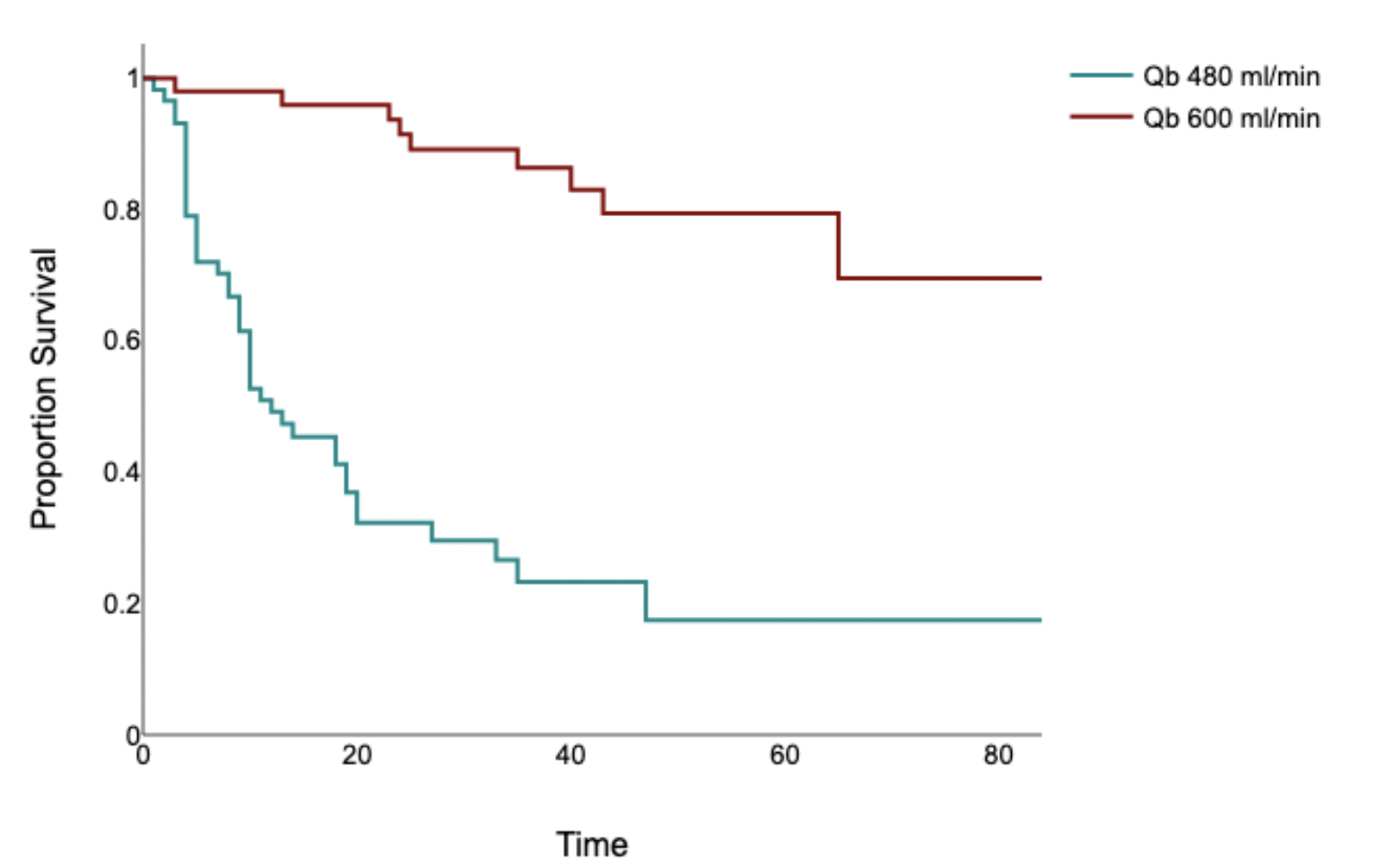
Resultados: fueron 58 casos en el grupo 1 y 50 en el grupo 2. No se encontraron diferencias en la edad, el sexo, el porcentaje de diabéticos, el peso ni el índice de masa corporal (Tabla 1). La supervivencia fue mayor en el grupo con mayor flujo extracorpóreo, con un beneficio de 37 meses.
Conclusiones: La optimización del flujo extracorpóreo a niveles muy altos (Qb aprox. 600 mL/min) mediante un incremento progresivo en pacientes con fístula arteriovenosa en hemodiafiltración en línea (HDF-OL) de alto volumen es una estrategia viable, segura y con un impacto clínico sobresaliente. Lejos de comprometer la estabilidad del acceso vascular, este protocolo de adaptación guiada demostró asociarse con un incremento significativo de la supervivencia de los pacientes (con un beneficio neto de 37 meses en comparación con el flujo óptimo convencional). Estos hallazgos sugieren la necesidad de replantear los límites tradicionales del flujo extracorpóreo, posicionando el Qb muy alto como un pilar terapéutico clave para maximizar los resultados clínicos en la enfermedad renal crónica terminal.
Publicado
Número
Sección
Licencia
Derechos de autor 2026 Franklin Mora Bravo, Pamela Tatianna Morales Torres, Samantha Pineda, Adriana Chicaiza. (Author)

Esta obra está bajo una licencia internacional Creative Commons Atribución-NoComercial-CompartirIgual 4.0.
 10.56867