
Vigilancia digital en diálisis peritoneal: telemonitoreo y estratificación de riesgo como modelo escalable de atención a nivel nacional.
DOI:
https://doi.org/10.56867/Palabras clave:
Telemonitoreo, Diálisis peritoneal, Estratificación de riesgoResumen
Introducción: La diálisis peritoneal (DP) requiere adherencia a la técnica y vigilancia continua para prevenir complicaciones. Las tecnologías digitales permiten ampliar el seguimiento y optimizar la atención. El objetivo fue describir la implementación de un programa de telemonitoreo liderado por enfermería y los resultados de una calculadora digital de riesgo en pacientes con DP.
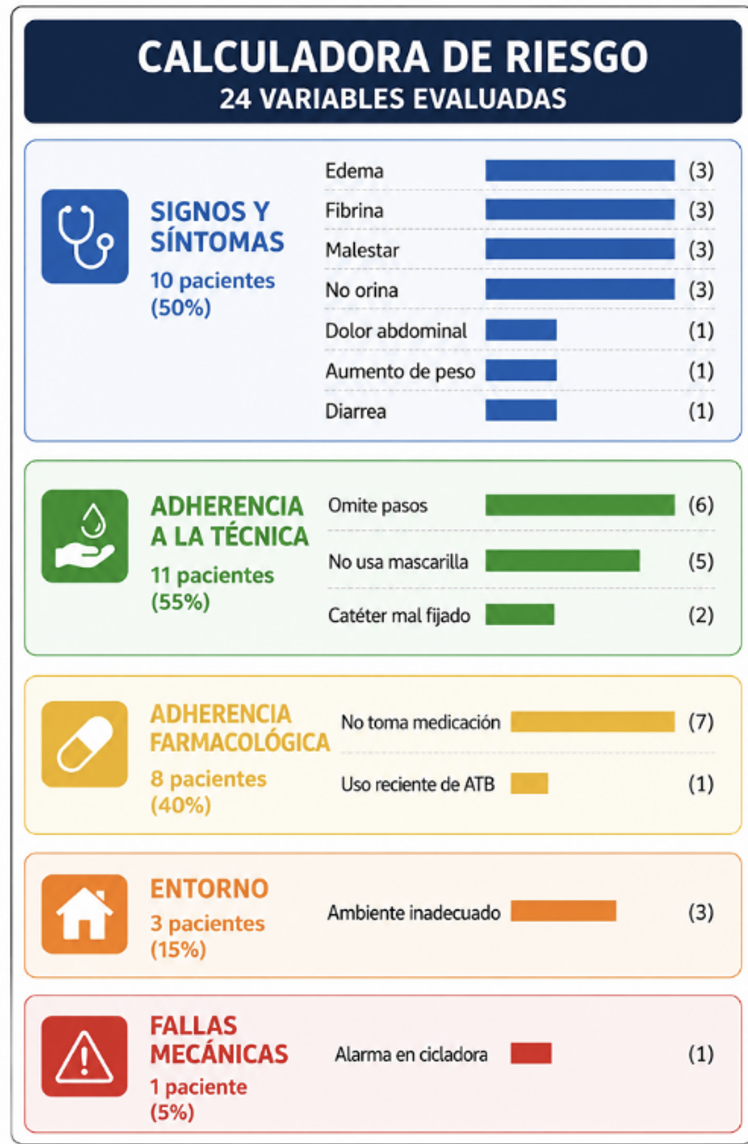
Materiales y métodos: estudio observacional, prospectivo y descriptivo realizado entre febrero y junio de 2026 en el programa de DP del Hospital General Docente de Calderón. Se realizaron videollamadas por Zoom para la evaluación clínica, técnica dialítica, de adherencia farmacológica y del entorno domiciliario. Se desarrolló una calculadora digital con 24 variables agrupadas en cinco áreas: manifestaciones clínicas, técnica dialítica, adherencia farmacológica, entorno domiciliario y fallas mecánicas. Los pacientes fueron estratificados en riesgo bajo (0–3), intermedio (4–7) y alto (≥8 puntos).
Resultados: Se realizó telemonitoreo en 20 pacientes, con una edad media de 42,9 ± 12,9 años, 60% de mujeres y una permanencia media en DP de 24,2 ± 23,0 meses. La calculadora clasificó a 12 pacientes (60%) como de bajo riesgo y a 8 (40%) como de riesgo intermedio, sin pacientes de alto riesgo. Durante el telemonitoreo se identificaron situaciones susceptibles de intervención en la mayoría de los pacientes. Los hallazgos más frecuentes fueron errores en la técnica dialítica (11; 55%), manifestaciones clínicas (10; 50%) y problemas de adherencia farmacológica u hospitalización reciente (8; 40%), seguidos de condiciones inadecuadas del entorno (3; 15%) y fallas mecánicas (1; 5%). Se realizaron intervenciones educativas y reevaluación temprana en 8 pacientes (40%), sin requerir derivación presencial, y los hallazgos se resolvieron oportunamente.
Conclusiones: El telemonitoreo permitió identificar situaciones modificables y la calculadora digital facilitó la estratificación del riesgo y la definición de intervenciones individualizadas, lo que demuestra la factibilidad de fortalecer la vigilancia en DP y de promover modelos digitales escalables a nivel nacional.
Descargas
Publicado
Número
Sección
Licencia
Derechos de autor 2026 Cristina Chediak, Mercy Yerovi, Belén Larco, Elsy Escudero, Patricia Chipantaxi, Adela Angüisaca, Ángel Santillán. (Author)

Esta obra está bajo una licencia internacional Creative Commons Atribución-NoComercial-CompartirIgual 4.0.
 10.56867