
Relación de la hipopotasemia con mortalidad cardiovascular y diuresis residual en pacientes en hemodiálisis trisemanal.
DOI:
https://doi.org/10.56867/Palabras clave:
Hipopotasemia, Mortalidad cardiovascular, Diuresis residualResumen
Introducción: Las alteraciones del metabolismo del potasio son frecuentes en pacientes en diálisis y se asocian con un mayor riesgo de arritmias y de mortalidad cardiovascular. La concentración de potasio en el líquido de diálisis, la corrección de la acidosis metabólica y la función renal residual influyen en la cinética del potasio durante la diálisis.
Materiales y métodos: Estudio observacional en el que se analizaron las concentraciones séricas de potasio antes y después de la sesión de diálisis, la presencia de diuresis residual y la causa de muerte cardiovascular; se utilizó un concentrado ácido con 2 mmol/L de potasio.
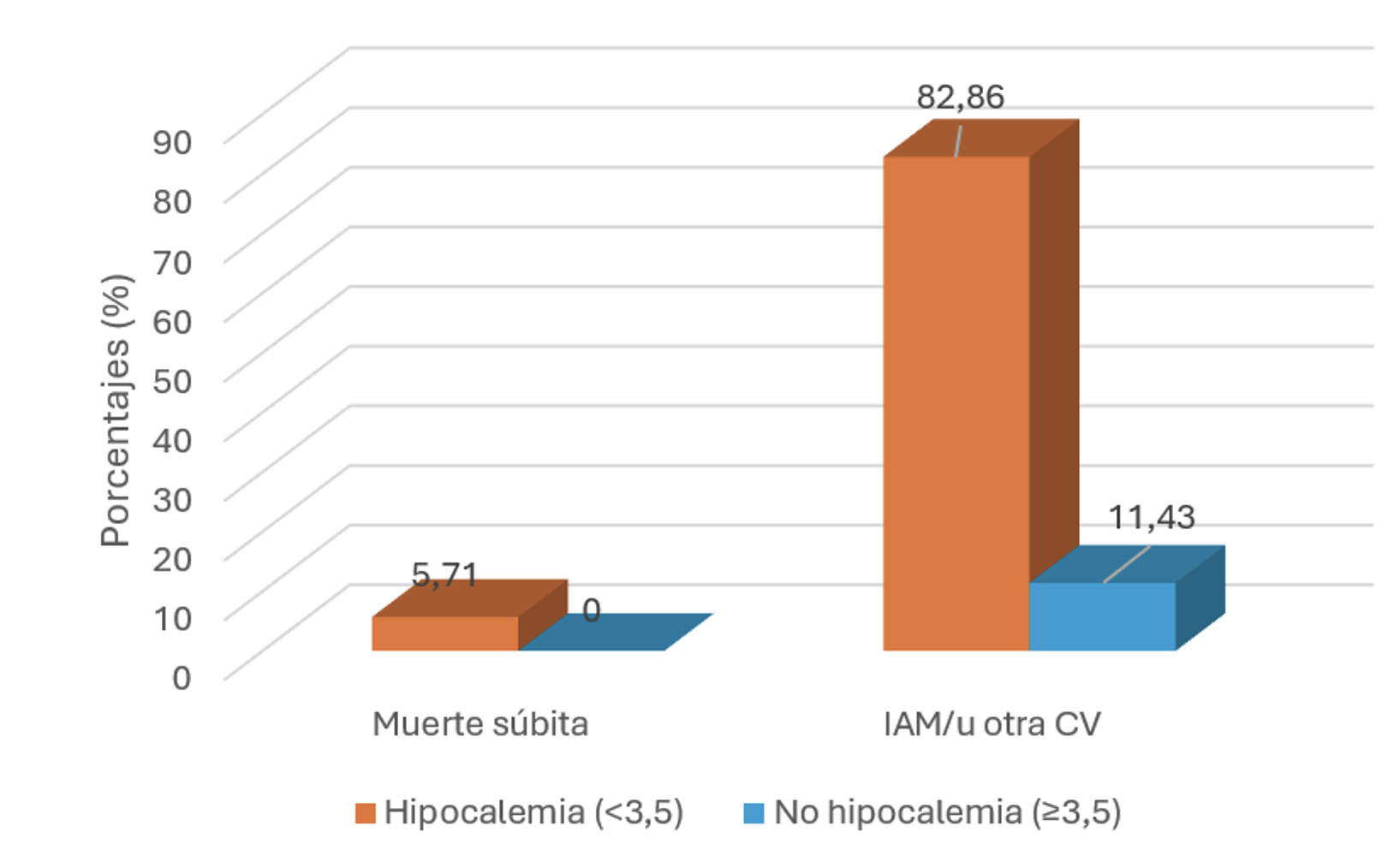
Resultados: Se estudiaron 35 pacientes, con predominio masculino (62,9%) y edad ≥ 65 años (60%). La etiología principal: diabetes mellitus (51,4%). El potasio sérico descendió significativamente tras la diálisis (de 4,84±0,86 a 3,20±0,30 mEq/L; p<0,001), y la hipocalemia postdiálisis (<3,5 mEq/L) fue muy frecuente (88,6%). No se encontró asociación significativa con el tipo de muerte cardiovascular (p=1,000) ni con la diuresis residual (p=0,268), aunque esta fue más frecuente en pacientes sin diuresis residual (92,3% vs 77,8%). El análisis de Spearman mostró que el tiempo en hemodiálisis se correlacionó inversamente con el potasio pre y postdiálisis (ρ=-0,392 y -0,382; p<0,05), y existió una fuerte correlación positiva entre ambos valores de potasio (ρ=0,756; p<0,001). No se hallaron correlaciones significativas entre los niveles de potasio y la causa de muerte ni con las variables demográficas (p>0,05).
Conclusiones: La hipopotasemia posdiálisis fue altamente prevalente, aunque no hubo asociación significativa con la diuresis residual ni con la mortalidad cardiovascular, es necesario individualizar la prescripción del potasio en el líquido de diálisis y realizar un seguimiento en pacientes con mayor riesgo de alteraciones del balance de potasio.
Publicado
Número
Sección
Licencia
Derechos de autor 2026 Fausto Giler, L Zambrano, V Aragundi, M Pita, R Macías, G Tamayo, Jorge Quinchuela, L Briones. (Author)

Esta obra está bajo una licencia internacional Creative Commons Atribución-NoComercial-CompartirIgual 4.0.
 10.56867