
Asociación entre el uso de químicos en la agricultura y el desarrollo de enfermedad renal crónica idiopática en pacientes hemodializados de 4 clínicas del Guayas.
DOI:
https://doi.org/10.56867/173Palabras clave:
Agroquímicos, Asociación estadística, Enfermedad Renal crónicaResumen
Introducción: La enfermedad renal crónica de etiología no tradicional (ERCI) representa un problema creciente en poblaciones agrícolas expuestas a factores ambientales y químicos. La exposición prolongada a agroquímicos se ha propuesto como posible factor de riesgo para el desarrollo de ERCI, aunque su asociación aún no está plenamente establecida.
Materiales y métodos: Se realizó un estudio observacional, retrospectivo, de cohorte longitudinal y analítico en 4 centros de diálisis. Se incluyeron 882 pacientes hemodializados, de los cuales 295 cumplieron los criterios de inclusión y presentaron diagnóstico de ERCI. Se analizaron variables sociodemográficas, antecedentes ocupacionales y la exposición a productos químicos agrícolas. La asociación entre exposición y ERCI se evaluó mediante el Odds Ratio (OR) y el intervalo de confianza del 95%, con un nivel de significancia estadística de p<0.05.
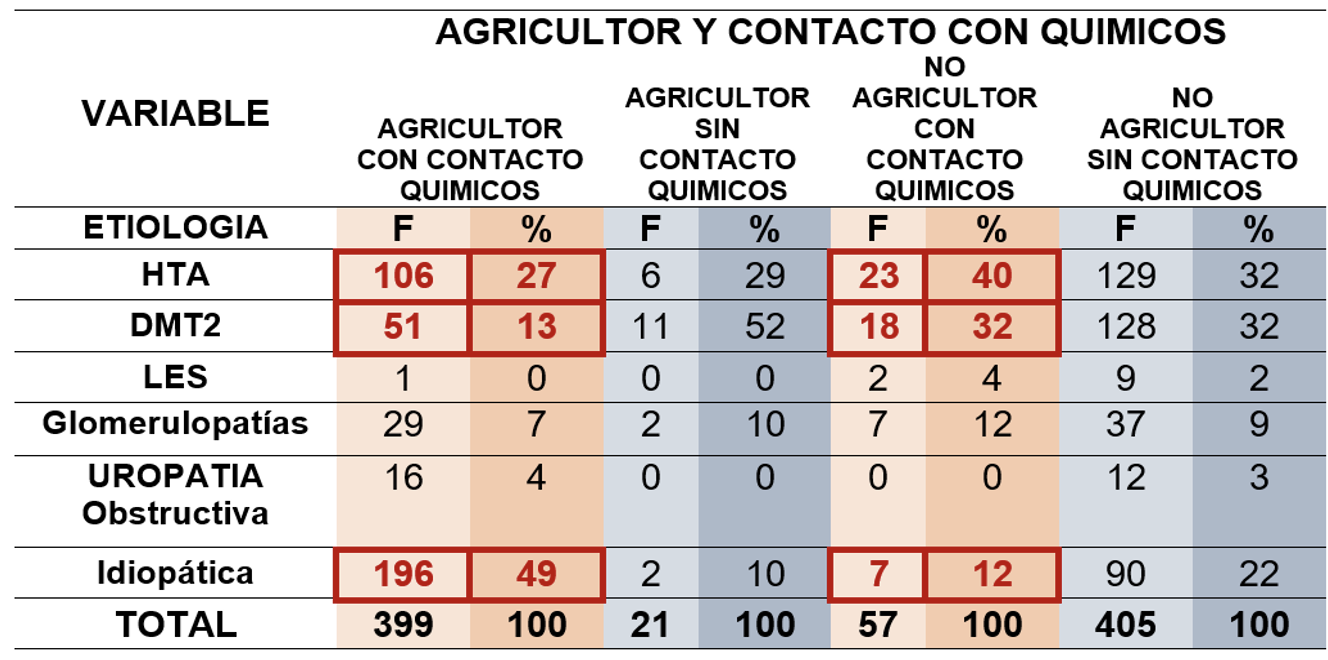
Resultados: Los pacientes expuestos a químicos fueron predominantemente hombres (93%), de residencia rural (80%) y agricultores previos a la diálisis (88%). En este grupo, la ERCI fue la etiología más frecuente (45%). Entre los no expuestos, predominó la diabetes mellitus tipo 2 (33%). De los pacientes con ERCI, el 67% eran agricultores y el 76% residían en zonas rurales. El 97% de los expuestos tuvo más de 10 años de exposición. El análisis bivariado mostró que la exposición a químicos agrícolas incrementa el riesgo de ERCI (OR=260; IC95%: 256.64–6186.07; p<0.001) y que una mayor exposición durante 10 años aumenta el riesgo (OR=416; IC95%: 135.99–1273.65; p<0.001).
Conclusiones: Existe una asociación significativa entre la exposición prolongada a químicos agrícolas y el desarrollo de ERCI en pacientes hemodializados, especialmente en trabajadores agrícolas con más de 10 años de exposición. La exposición prolongada, la falta de uso de medidas de bioseguridad; determinan escenarios sombríos para esta población. Estos hallazgos respaldan la necesidad de estrategias preventivas en poblaciones rurales expuestas.
Publicado
Número
Sección
Licencia
Derechos de autor 2026 García Ordóñez Danny, García Cedeño Paola, Marcano Díaz Virginia, Villarreal Quintero Jorge, Pazmiño Rojas Dorys. (Author)

Esta obra está bajo una licencia internacional Creative Commons Atribución-NoComercial-CompartirIgual 4.0.
 10.56867