
Síndrome nefrótico secundario a glomeruloesclerosis focal y segmentariaen un paciente con VIH controlado: reporte de caso.
A case report.
DOI:
https://doi.org/10.56867/172Palabras clave:
Síndrome nefrótico secundario, Glomeruloesclerosis focal y segmentaria, VIH, Reporte de casoResumen
Introducción: La glomeruloesclerosis focal y segmentaria (GEFS) es una de las principales causas de síndrome nefrótico en adultos y contribuye significativamente a la progresión de la enfermedad renal crónica. En
pacientes con infección por VIH, las glomerulopatías suelen asociarse con replicación viral activa y deterioro inmunológico; sin embargo, su aparición en individuos con supresión virológica sostenida representa un desafío diagnóstico y terapéutico. Presentamos el caso de un paciente joven con VIH controlado que desarrolló síndrome nefrótico secundario a GEFS confirmada por biopsia renal.
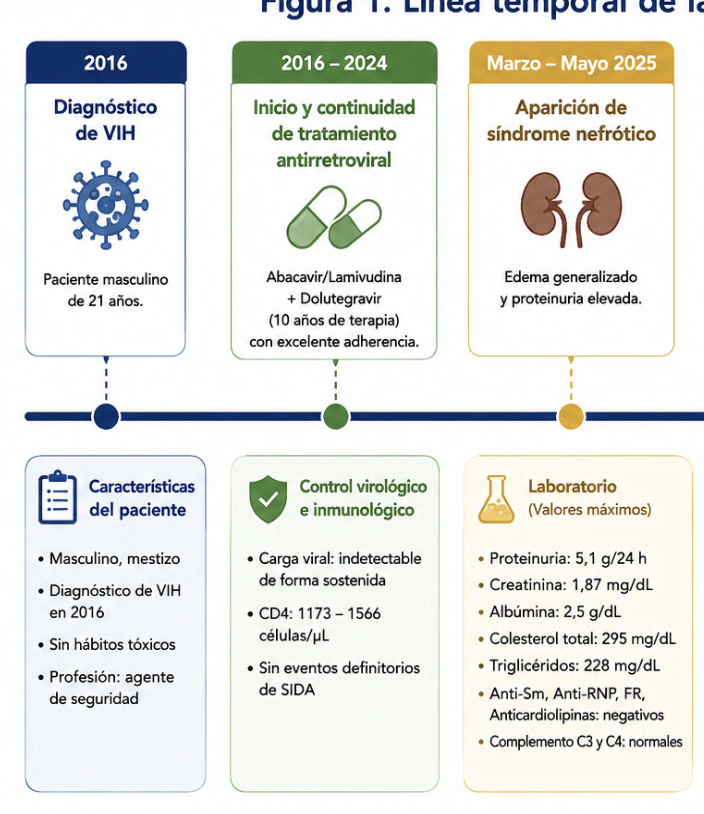
Materiales y métodos: Se presenta un reporte de caso de un hombre mestizo de 31 años con antecedente de infección por VIH desde 2016, en tratamiento continuo con abacavir/lamivudina y dolutegravir, con carga viral persistentemente indetectable y adecuada reconstitución inmunológica. Se revisaron la historia clínica, estudios de laboratorio, ecografía renal y biopsia renal para establecer el diagnóstico e instaurar el tratamiento.
Resultados: El paciente presentó proteinuria en rango nefrótico (5,1 g/24 h), creatinina entre 1,46 y 1,87 mg/dL y perfil inmunológico negativo para enfermedades autoinmunes. La ecografía mostró riñones de tamaño conservado con alteración de la ecogenicidad corticomedular y litiasis bilateral no obstructiva. La biopsia renal confirmó GEFS con fibrosis intersticial y atrofia tubular leve (20%). Se instauró tratamiento con losartán, espironolactona, empagliflozina, prednisona y tacrolimus, manteniendo simultáneamente el tratamiento antirretroviral, con persistencia de carga viral indetectable y estabilidad inmunológica.
Conclusiones: La GEFS puede presentarse en pacientes con infección por VIH adecuadamente controlada, incluso en ausencia de replicación viral y con recuentos elevados de linfocitos CD4, aunque esta presentación es menos frecuente que la nefropatía asociada al VIH clásica (2–4). La biopsia renal fue determinante para establecer el diagnóstico y orientar el tratamiento inmunosupresor, destacando la importancia de considerar otras etiologías de síndrome nefrótico en personas con VIH y realizar una evaluación nefrológica integral para optimizar el manejo y preservar la función renal (1,4).
Publicado
Número
Sección
Licencia
Derechos de autor 2026 Karla Amanda Manzano Bayas, Karla Gabriela Ramos Burgos, Nieve Karina Peña Ponce (Author)

Esta obra está bajo una licencia internacional Creative Commons Atribución-NoComercial-CompartirIgual 4.0.
 10.56867