
Hemoadsorption for acute pesticide and drug poisoning in Ecuador: a multicenter retrospective observational study of local experience over 13 years.
DOI:
https://doi.org/10.56867/Keywords:
Hemoadsorption, Acute pesticide and drug poisoning, ParaquatAbstract
Introduction: Pesticides and other drugs frequently cause acute poisoning (AP) in Ecuador. Reported mortality is high. Hemoadsorption (HA) offers a therapeutic option for removing certain toxins, yet its use remains limited.
Objective: To evaluate clinical outcomes in patients with AP treated with HA and to identify factors associated with mortality.
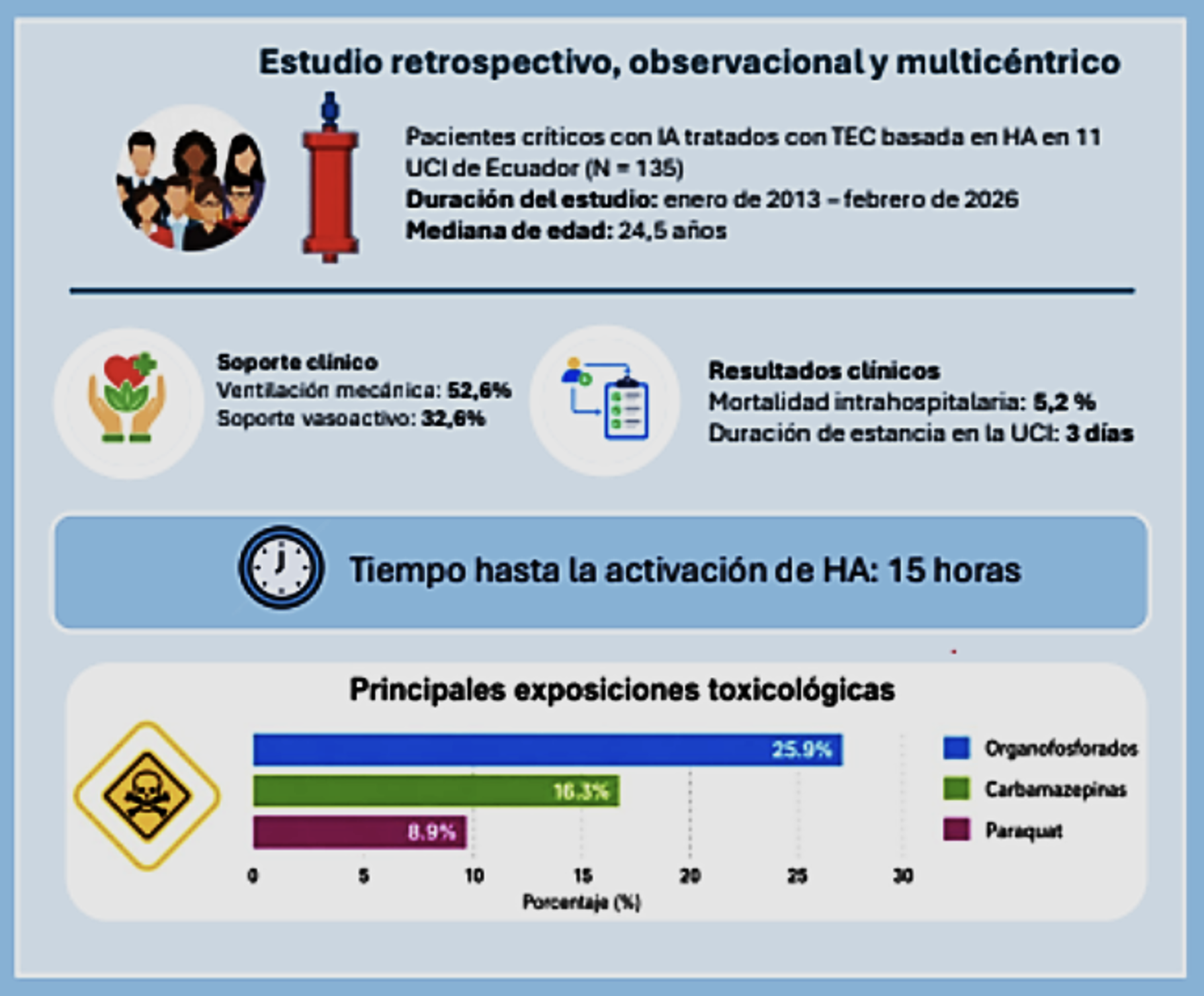
Materials and Methods: A multicenter, retrospective, observational-analytical study was conducted on critically ill adult patients with AP treated with HA—either alone or combined with intermittent hemodialysis—across 11 ICUs in Ecuador (January 2013–February 2026). Clinical characteristics, type of toxin, organ support, and in-hospital mortality were analyzed. Additionally, an exploratory multivariable logistic regression was performed.
Results: The study included 135 critically ill patients with AP treated with HA. The median age was 24.5 years, and 57.8% were female. Organophosphate poisoning was the most frequent exposure (25.9%), followed by carbamazepine (16.3%) and paraquat (8.9%). Mechanical ventilation was required in 52.6% of cases, and vasoactive agents in 32.6%. The median ICU stay was 3 days, and in-hospital mortality was 5.2%. Non-survivors were older and presented with higher SOFA scores, longer durations of mechanical ventilation, and a greater number of hemoadsorption sessions. In the multivariable analysis, paraquat showed a significant association with in-hospital mortality (adjusted OR: 6.36; 95% CI: 1.13–35.86; p = 0.036), while the SOFA score showed a non-significant trend.
Conclusions: HA is a feasible strategy for critically ill patients with AP. Mortality was low and showed a statistically significant association with the type of toxic agent (paraquat), the SOFA score, the duration of mechanical ventilation, and the number of sessions required. No difference was observed regarding the time elapsed between toxic ingestion and the initiation of therapy, supporting a recommendation for earlier treatment initiation in all types of poisoning. Prospective, controlled studies are needed to define efficacy, the optimal timing of administration, and patient selection criteria.
Downloads
Published
Issue
Section
License
Copyright (c) 2026 Joseph Paredes, Jazmín Jiménez, Andrés Herdoiza, Darío Jiménez. (Author)

This work is licensed under a Creative Commons Attribution-NonCommercial-ShareAlike 4.0 International License.
 10.56867