
Impacto del sellado con Gentamicina sobre la infección asociada a catéter venoso central en pacientes en hemodiálisis
Experiencia de FREIAT- Ecuador (2017–2026).
DOI:
https://doi.org/10.56867/177Palabras clave:
Sellado de catéteres con Gentamicina, Catéter de hemodiálisis, InfeccionesResumen
Introducción: La infección asociada a catéter venoso central (CVC) constituye una de las principales complicaciones en pacientes sometidos a hemodiálisis, incrementando la morbimortalidad, los costos sanitarios y las hospitalizaciones. Diversas estrategias preventivas han sido implementadas para disminuir su incidencia, entre ellas el sellado intraluminal con antibióticos. El objetivo de este estudio fue identificar los factores asociados a la infección relacionada con CVC y evaluar la eficacia del protocolo de sellado con gentamicina implementado en FREIAT a partir de 2022.
Métodos: estudio observacional retrospectivo realizado en una unidad de hemodiálisis de Ecuador (FREIAT). Se analizaron 197 registros de pacientes con CVC entre 2017 y 2026. Se evaluaron variables demográficas, comorbilidades, estado nutricional, higiene personal, tiempo de permanencia del catéter y uso de sellado con gentamicina a partir de 2022. Se realizaron análisis descriptivos y comparativos, utilizando pruebas de asociación, para determinar los factores asociados a la presencia de infección.
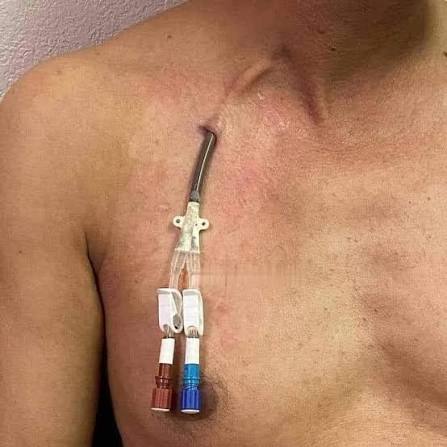
Resultados: Se analizaron 197 episodios de infección. La edad media fue de 58,6 ± 17,7 años y el 57,1% correspondió al sexo femenino. La hipertensión arterial estuvo presente en el 87,3% y la diabetes mellitus en el 48,2%. El tiempo medio de permanencia del catéter fue de 14,7 ± 13,6 meses. De los 197 episodios evaluados, 78 (39,6%) presentaron cultivos positivos y 119 (60,4%), negativos. Los microorganismos aislados correspondieron predominantemente a bacilos gramnegativos, destacándose Escherichia coli, Enterobacter spp y Klebsiella pneumoniae. Entre los cocos Gram positivos, los microorganismos más frecuentes fueron Staphylococcus coagulasa negativa y Staphylococcus aureus. Al comparar los episodios según el uso de sellado con gentamicina, la proporción de cultivos positivos fue de 41,5% en pacientes sin sellado y de 36,7% en aquellos que recibieron sellado con gentamicina, observándose una reducción relativa del 11,6%. No obstante, esta diferencia no alcanzó significación estadística (p=0,597). Teniendo en cuenta que, después del uso de gentamicina, tenemos 7 de rescate de estafilococo coagulasa negativo, los cuales se podrían considerar contaminación externa; asimismo, en 6 episodios no presentaron sellado de gentamicina por diferentes causas, y 1 paciente que recién ingresó se tomó muestra de cultivo, siendo positivo. Tras la implementación del protocolo, se observó una disminución progresiva del número anual de infecciones, pasando de 16 episodios en 2022 a 8 en 2023, 4 en 2024, 4 en 2025 y ninguno en el período analizado de 2026. Asimismo, se observó una tendencia a niveles más bajos de albúmina sérica en los pacientes infectados. La higiene personal deficiente se asoció de manera significativa con un mayor porcentaje de infecciones. La mayoría de los episodios ocurrieron en catéteres yugulares tunelizados. Sin embargo, desde el punto de vista epidemiológico, esto no implica necesariamente que tengan un mayor riesgo, ya que también son los catéteres más utilizados en la unidad. "Los catéteres yugulares tunelizados fueron el acceso vascular más frecuente en los episodios de infección registrados."
Conclusiones: El sellado profiláctico con gentamicina se asoció con una reducción significativa de las infecciones relacionadas con CVC en pacientes en hemodiálisis. Los bacilos gramnegativos constituyeron los microorganismos predominantes, siendo Escherichia coli y Enterobacter spp. los agentes aislados con mayor frecuencia. La higiene personal deficiente y la permanencia prolongada del catéter emergieron como factores de riesgo relevantes. Estos hallazgos respaldan la continuidad del protocolo de sellado con gentamicina como estrategia efectiva de prevención en unidades de hemodiálisis.
Descargas
Publicado
Número
Sección
Licencia
Derechos de autor 2026 Nelson Rojas C, Francisca Chavarría B, Carlos Villacis, Claudina González B, Denisse Marriott B, Irvin Rojas C, Guillermina Blum C. (Author)

Esta obra está bajo una licencia internacional Creative Commons Atribución-NoComercial-CompartirIgual 4.0.
 10.56867